Survey, 2013-05-20, Black Sea

Sochi shelf 2013, Mzymta and Kudepsta plumes

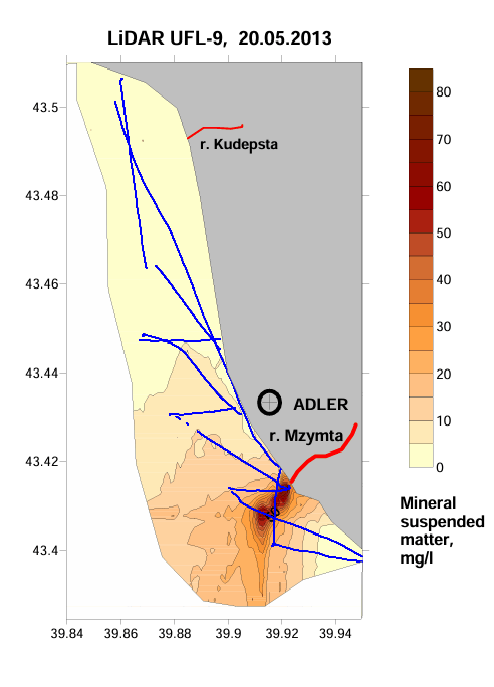
A single-day survey on 20 May 2013 across the Sochi shelf, running repeat transects through the outflow of the Mzymta and Kudepsta rivers at the height of the Caucasus snowmelt. Mineral suspended matter reaches above 80 mg/L on the Mzymta mouth and falls to near zero within two kilometres of it.

Published figures

Interpolated fields from the campaign, reproduced as issued. Plate titles carry the LIFL-9 under its original designation, UFL-9.

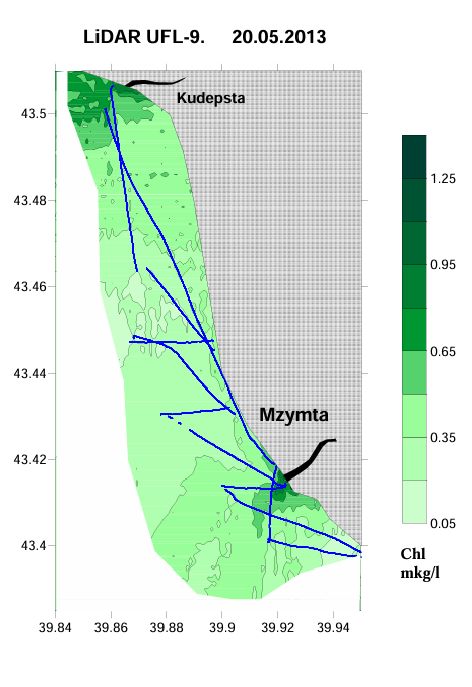
Interpolated chlorophyll a field over repeat transects off Adler, peaking on the Mzymta mouth, Sochi shelf, 20 May 2013
Fig. 1Chlorophyll a
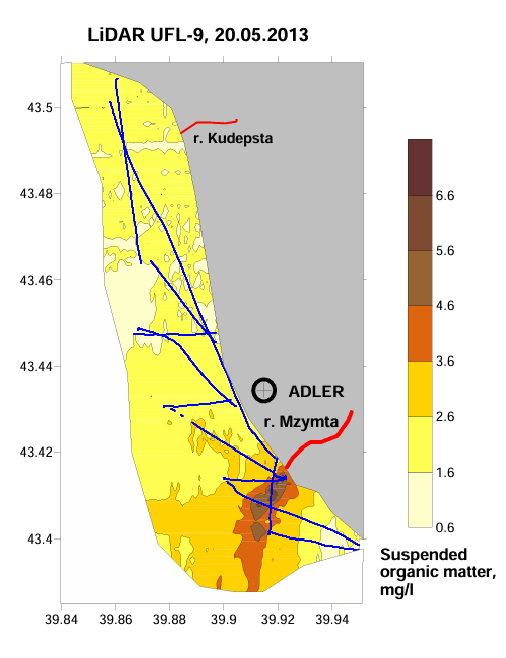
Interpolated suspended organic matter field over repeat transects off Adler, peaking on the Mzymta mouth, Sochi shelf, 20 May 2013
Fig. 2Suspended organic matter
Interpolated mineral suspended matter field over repeat transects off Adler, reaching above 80 mg/L on the Mzymta mouth, Sochi shelf, 20 May 2013
Fig. 3Mineral suspended matter

The Mzymta and Kudepsta enter the Black Sea a few kilometres apart on the Sochi coast, and in late May they are carrying snowmelt off the western Caucasus. The shelf is narrow here, so the plume has little room to spread before the bottom drops away. On 20 May 2013 a LIF LiDAR ran repeat transects across both outflows, sampling continuously along the ship track rather than at stations.

Mineral suspended matter reaches above 80 mg/L directly on the Mzymta mouth and falls to near zero within about two kilometres of it. Chlorophyll a spans 0.05 to 1.25 µg/L over the same box and the suspended organic fraction 0.6 to 6.6 mg/L, both peaking on the same spot. That peak is a few hundred metres across, narrower than the spacing of any practical station grid, so whether it appears in the data at all is settled when the stations are placed.

The same shelf was surveyed on 27 May 2010, three years earlier and a week later in the season. Read against that campaign, the pair gives the Mzymta plume at two points in the same snowmelt window.