Survey, 2016-04-09, Caspian Sea

Caspian Sea 2016, Volga delta front

An April 2016 survey of the northern Caspian off the Volga delta, 98,080 returns across one of the most turbid, organically loaded water masses in the archive, with median suspended matter above 45 mg/L and chlorophyll near 8 µg/L where Europe's largest river meets the sea.

Published figures

Interpolated fields from the campaign, reproduced as issued. Plate titles carry the LIFL-9 under its original designation, UFL-9.

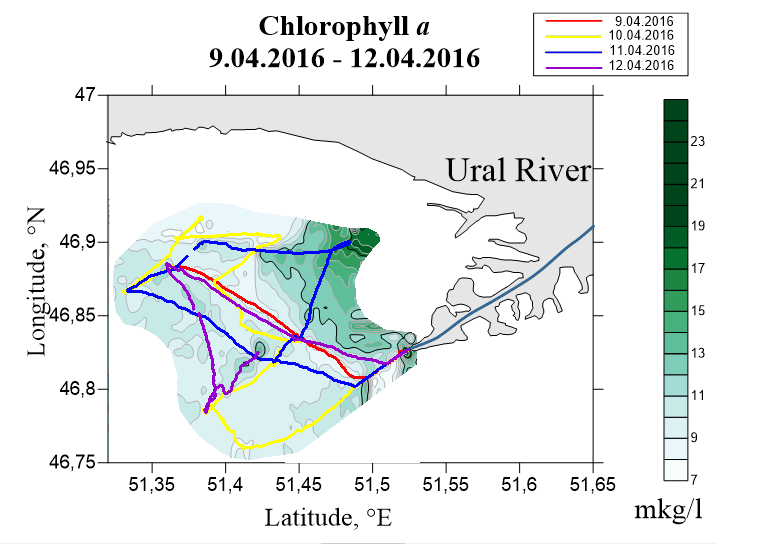
Interpolated chlorophyll a field mapped along the lidar track, Northern Caspian, Volga delta, Northern Caspian, 2016
Fig. 1Chlorophyll a
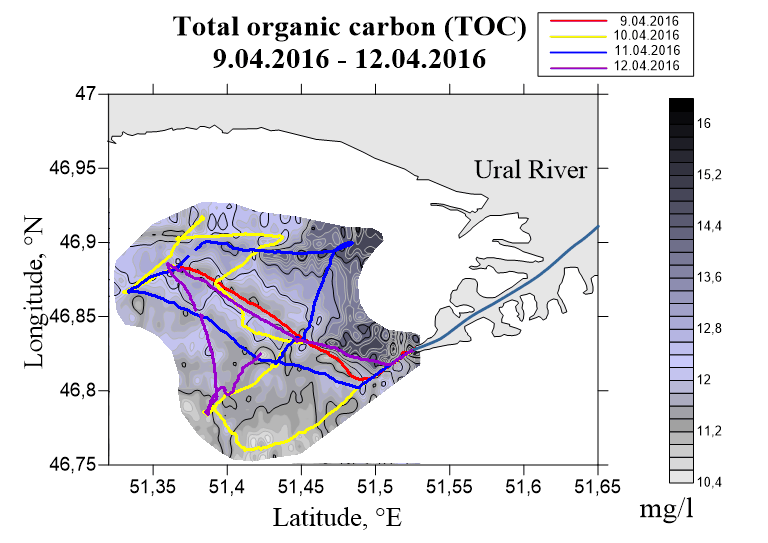
Interpolated total organic carbon field mapped along the lidar track, Northern Caspian, Volga delta, Northern Caspian, 2016
Fig. 2Total organic carbon
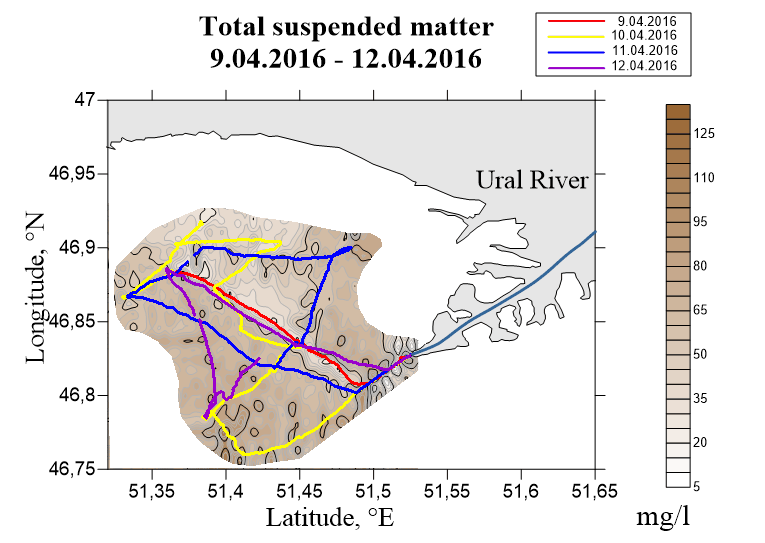
Interpolated total suspended matter field mapped along the lidar track, Northern Caspian, Volga delta, Northern Caspian, 2016
Fig. 3Total suspended matter
Northern Caspian / Volga deltaCaspian Sea
5 km
● Caspian Sea 2016, Volga delta, 2016-04-09 → 2016-04-1298,080 measurements IDW interpolation, 600 samples
Chl-a3.6025.6µg/L
CDOM9.5415.0a.u.
TSS23.0130mg/L

Fig. 4 Campaign scan. 98,080 lidar returns along the ship track, switchable across Chl-a, CDOM, TSS. Field view interpolates the channel across the surveyed water from the same measurements (inverse-distance weighting). Shoreline: Natural Earth.

The northern Caspian is shallow and dominated by the Volga, which delivers the bulk of the river inflow to the world’s largest enclosed water body. In April 2016, at the spring freshet, a LIF LiDAR logged 98,080 returns across the delta front, sampling chlorophyll a, CDOM and total suspended matter through the plume.

The water here is at the turbid, eutrophic extreme of the company’s field record: median suspended matter above 45 mg/L, CDOM near 12 a.u., and chlorophyll a around 8 µg/L, all rising sharply into the freshest delta water. Mapping that front continuously, where three strong and co-varying optical signals overlap, is a demanding test of constituent separation, and the kind of inland-sea, river-dominated regime where satellite retrievals most need in-water ground truth.