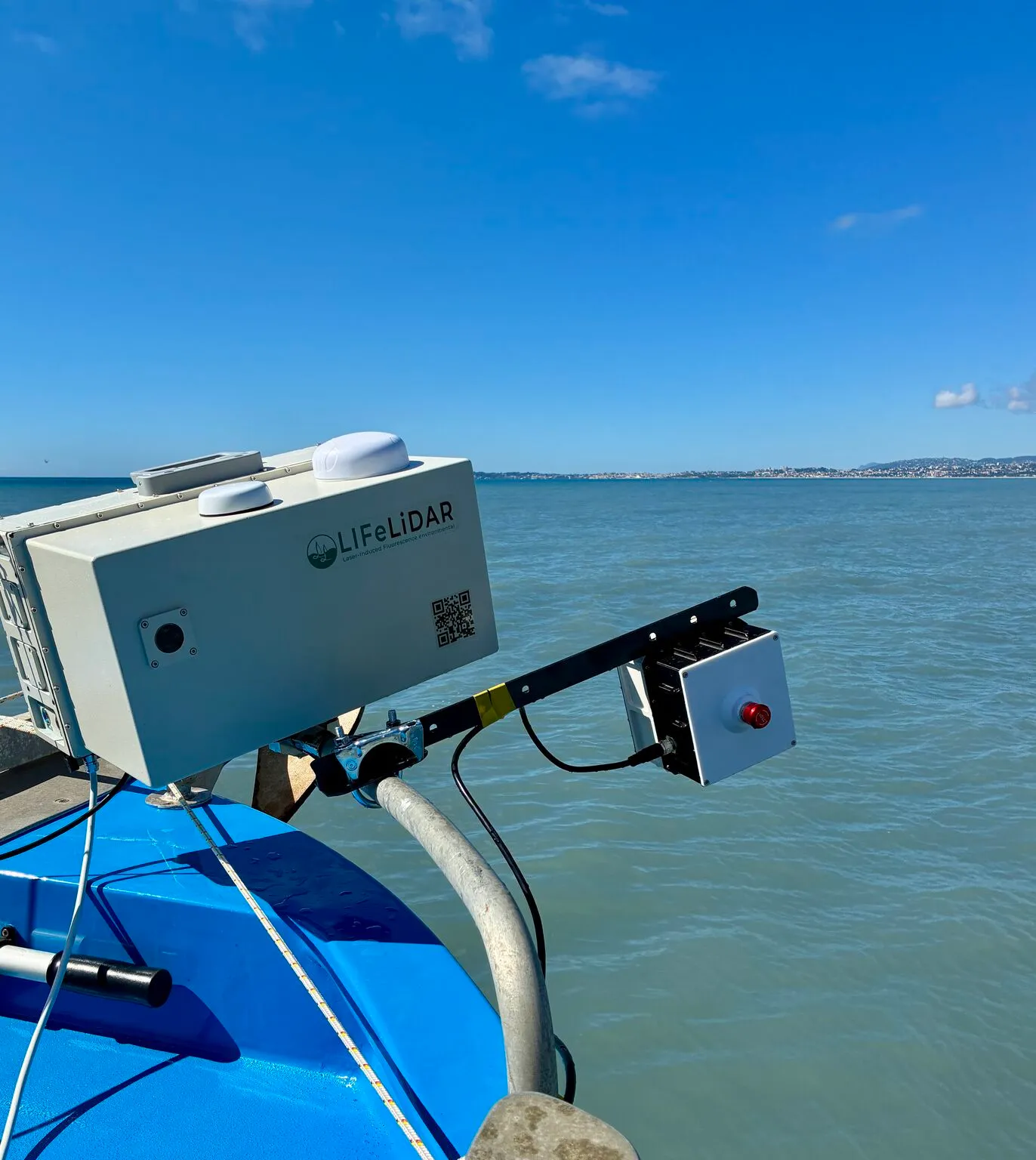
On 7 May, the team ran a westward coastal transect aboard R/V Sagitta III from Villefranche-sur-Mer to the mouth of the Var near Nice. The campaign was conducted with the Laboratoire d’Océanographie de Villefranche after heavy rainfall had produced a turbid river plume along the coast.
The route crossed the plume and the clearer Mediterranean water beyond it within a single transect. This provided a useful test of the instrument response across a strong optical gradient without changing the acquisition configuration.
Secchi depth was 0.46 m in the plume core and 16 m offshore. The LIFL-11 mapped the plume boundary, recorded subsurface scattering layers associated with the river water, and profiled optical structure to approximately 30 m in the clearer offshore water.
The transect returned 29,791 lidar depth profiles at 2 Hz and 210,680 surface fluorescence measurements at 10 Hz across eight stations. Chlorophyll-a at 685 nm and CDOM at 440 nm both varied by more than an order of magnitude between the plume and offshore water. CTD and fluorometric profiles, Niskin samples, and Secchi measurements provided the conventional reference set.
The mFL-12 and mHR-2 operated beside the LIFL-11, and the results are documented in the LIFL VarPlume field report. We thank the Laboratoire d’Océanographie de Villefranche and the crew of R/V Sagitta III for their support.